
External Events (since 2023)
2026
27–29 April 2026 | Lecture in Córdoba | Yoav Meyrav
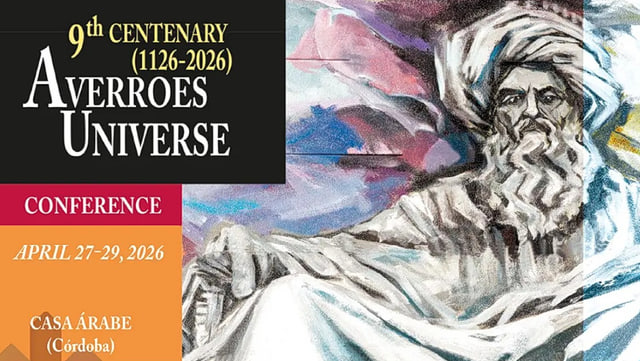
Venue
Averroes/Ibn Rushd, Intellectual and His Time: International Conference Commemorating the Ninth Century of His Birth, Córdoba
Date
27–29 April 2026
Lecture
Averroes Hebraicus: State of the Art and Future Directions
Yoav Meyrav
Yoav Meyrav will show how Hebrew materials discovered in the context of the HEPMASITE project can potentially transform our understanding of several aspects in Averroes’s thought and philosophical evolution.
Further information
Link to conference webpage and programme
15 April 2026 | Lecture in Venice | Yoav Meyrav
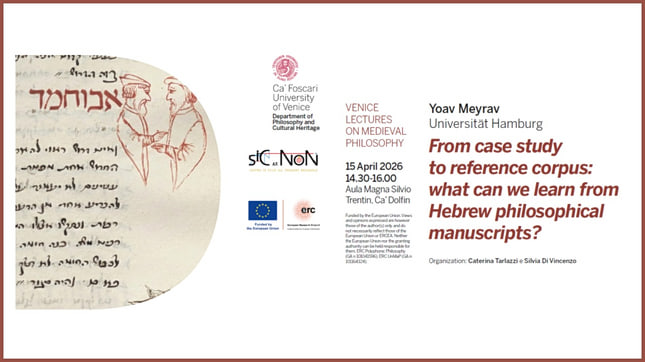
Venue
Venice Lectures on Medieval Philosophy, Ca' Foscari University of Venice
Date
15 April 2026
Lecture
From Case Study to Reference Corpus: What Can We Learn from Hebrew Philosophical Manuscripts?
Yoav Meyrav
The lecture will offer some general insights concerning the corpus of Hebrew philosophical manuscripts and ask if and how they can be found in other philosophical traditions.
Further information
Invitation poster: PDF download
13 April 2026 | Lecture in Venice | Yoav Meyrav

Venue
Seminar on the Ancient Philosophical Heritage and its Afterlife, first cycle (3 March-27 May 2026): “Aristotle’s Metaphysics in the Greek and Arabic Traditions,” Ca' Foscari University of Venice
Date
13 April 2026
Lecture
Averroes’ Changing Views on God and the World in his Commentaries on Aristotle’s Metaphysics: New Evidence from Hebrew Manuscripts
Yoav Meyrav
In the lecture, it will be argued that the examination of Hebrew manuscripts of Averroes’ works on Aristotle’s Metaphysics has a transformative potential for understanding the evolution of his thought about key philosophical issues.
Further information
Invitation poster: PDF download
19 March 2026 | Lecture in Hamburg | Hanna Gentili and Yoav Meyrav
Venue
Fifth PESHAT in Context International Conference on "The Study of Premodern Philosophic and Scientific Hebrew Terminology: Results and Perspectives," Institute for Jewish Studies, University of Hamburg
Date
17–19 March 2026
Presentation
HEPMASITE (Hebrew Philosophical Manuscripts as Sites of Engagement)
Hanna Gentili and Yoav Meyrav
Hanna Gentili and Yoav Meyrav presented the HEPMASITE project, its objectives, and its preliminary finding to the conference audience.
Further information
Link to conference programme on the PESHAT project webpage
2025
19–20 September 2025 | Lecture in Toronto | Yoav Meyrav

Venue
2025 Toronto Colloquium in Medieval Philosophy, Department of Philosophy, University of Toronto, Canada
Date
19–20 September 2025
Lecture
Hasdai Crescas and the Ex Uno Principle
Yoav Meyrav
This lecture explored Crescas’ understanding of the philosophers’ principle according to which “from the one and simple, only the one and simple is necessitated."
Further information
Link to colloquium webpage and programme
2–4 July 2025 | Lectures in Lisbon | Hanna Gentili and Yoav Meyrav

Venue
International Aristotelian Conference, School of Arts and Humanities, University of Lisbon, Portugal
Date
2–4 July 2025
Panel: Prime Matter in Medieval and Early Modern Hebrew Scientific Literature
Organisers: Hanna Gentili, Yoav Meyrav, Suf Amichay
Panel Abstract
The concept of Prime Matter was at the centre of some of the most contested philosophical and metaphysical discussions in the medieval tradition. Although contemporary opinions differ regarding Aristotle’s own commitment to Prime Matter, medieval thinkers saw it as integral to Aristotelian natural philosophy. Hebrew sources represent an important link in the chain of transmission that shaped the view of Prime Matter in medieval and early modern thought and played an important role by both inheriting and reverberating Arabic debates and developing an original tradition specific to the Jewish context. It also demonstrates how a philosophical notion can stray so far away from the context in which it was originally developed and still be of philosophical value.
Our panel addresses the multilayered contribution of Hebrew sources to the debates on Prime Matter as concerns the legacy of the Arabic tradition in the context of medieval and early modern Jewish philosophy as well as the original elements that the Jewish tradition added to it. Based mainly on underresearched manuscript sources that have never been printed, the three talks will provide new material for the discussion of the importance of Prime Matter in issues of cosmogony, natural philosophy and theory of science.
The talks will address respectively a) new material preserved in the Hebrew manuscript tradition that sheds light on the debates around Prime Matter in the Arabic world; b) the long-term influence of the Arabic debates in the Hebrew reception of Aristotelian natural philosophy; and c) new ways in which the notion of Prime Matter was integrated into the rabbinic and mystical tradition in the Jewish medieval and early modern context.
Prime Matter in Averroes’ Circle: New Sources in Hebrew Manuscripts
Hanna Gentili
This paper examines the discussion of Prime Matter in two medieval treatises originally written in Arabic by abū Jaʿfar ibn Sabāq and abū al-Qāsim ibn Idrīs, both likely associated with the intellectual circle of Averroes. Preserved only through an anonymous Hebrew translation, these treatises circulated with Averroes’ Questions in Physics, a collection which comprises of treatises on physics and metaphysics and is transmitted with the commentary by the 14th-century Jewish Aristotelian philosopher Moses Narboni. By analyzing these treatises, this paper sheds light on lesser-known contributors to Arabic philosophy and deepens our understanding of the debates around Prime Matter in the circle of Averroes.
Furthermore, the investigation into the multiple layers of the Hebrew transmission of these treatises and their larger impact on Moses Narboni’s thought will reveal their wider impact on medieval Jewish philosophy.
Medieval Hebrew Philosophers and the Scientific Status of Prime Matter
Yoav Meyrav
Medieval Hebrew authors encountered the question of the scientific status of Prime Matter—specifically, which science proves its existence and in which science it is discussed once its existence is proven—mainly in the context of Averroes’s commentaries on Aristotle’s Physics. This question was raised in connection with Averroes’s critical discussion of Avicenna’s division of labor between physics and metaphysics and also tied to the scientific status of Prime Matter’s counterpart, the First Mover (or the First Form). The proposed presentation will examine Hebrew philosophers’ positions on this question through two medieval genres: [1] supercommentaries on Averroes’s commentaries on Aristotle, whose authors—due to the limitations of this genre—were bound to follow Averroes’s line of discussion and decisions on where and in what contexts to address this question; and [2] encyclopedias, whose authors adopted a synthetic approach to their various sources and—due to the limitations of this genre—had to introduce and follow a clear distinction between sciences, making their positioning and analysis of Prime Matter indicative of their approach.
The Evolving Role of Prime Matter (Hyle) in the Esoteric Jewish Intellectual Tradition
Suf Amichay (University of Cambridge)
I examine the evolving importance of Prime Matter (hyle) in the Jewish intellectual tradition, specifically within a tradition of esoteric Jewish science. For background, I give a short overview of the reception of the Aristotelian theory of matter in the Jewish tradition in late antiquity, and its integration into Jewish sciences in the Middle Ages. The main part of the talk then focuses on a shift in the role Prime Matter played in esoteric traditions of science. Referring to both known texts and specific findings from manuscripts and marginalia, I show how in the Middle Ages, a commitment to an Aristotelian concept was taken in the esoteric tradition to be a commitment to the eternity of the world. I then show how following the scientific revolution, the Aristotelian concept of matter was ironically canonised as the official concept of matter by Rabbinic Jews.
Further information
Link to conference webpage
18 June 2025 | Lecture in Madrid | Yoav Meyrav

Venue
Lecture Series “Jewish-Islamic Resonances: A Journey through Medieval Texts and Ideas,” Institute of Languages and Cultures of the Mediterranean and the Near East (CCHS-CSIC), Madrid
Date
18 June 2025
Lecture and Interview
Philosophy on the Arabic-Hebrew Continuum: Between Manuscript Evidence and Material Causality
Yoav Meyrav
The lecture will outline several ways in which Hebrew manuscripts function as mediators of Arabic philosophy.
Further information
Link to lecture webpage
Jewish-Islamic Resonances Interview Series: A Meeting with Yoav Meyrav
Links to Youtube / interview section of HEPMASITE webpage
8 May 2025 | Lecture in Rome | Yoav Meyrav
Venue
Dipartmento di Filosofia, Sapienza University of Rome, Italy
Date
8 May 2025
Lecture
What is Philosophical about Philosophical Manuscripts?
Yoav Meyrav
The lecture focused on smaller details in Hebrew manuscripts and then moved to an ambitious argument pertaining to manuscripts of philosophy in general.
Further information
Link to lecture webpage and invitation poster (PDF)
2–3 April 2025 | Lectures in Frankfurt | Hanna Gentili and Yoav Meyrav
Venue
Workshop “Writing Philosophy in Jewish History—An Attempt at a New Methodological Approach,” Goethe University, Frankfurt am Main, Germany
Date
2–3 April 2025
Lectures
Formats of Medieval and Early Modern Philosophy
Hanna Gentili
The lecture examined the genres through which medieval and early modern Jewish philosophy was conveyed, including treatises, commentaries, dialogues, poems and sermons, as well as the significant role of the printing press in the dissemination of Jewish philosophy, both in Hebrew and in Latin.
The Hebrew Philosophical and Scientific Corpus before the Age of Print
Yoav Meyrav
The lecture outlined the scope and magnitude of philosophical literature in Hebrew before and/or outside print using a post-protagonist, itemized approach which privileges codices over authors.
Further information
Link to workshop programme (PDF)
20 February 2025 | Lecture in Cluj-Napoca | Yoav Meyrav
Venue
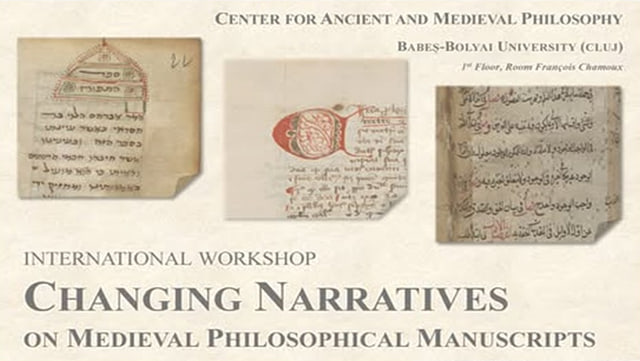
Workshop “Changing Narratives on Medieval Philosophical Manuscripts,” Babeș-Bolyai University, Cluj-Napoca, Romania
Date
20 February 2025
Lecture
From Textual Variation to Argumentative Fragility in Hebrew Manuscripts of Averroes's Metaphysics Commentaries
Yoav Meyrav
The lecture explored how phenomena in the Hebrew manuscripts of each of Averroes's commentaries on the Metaphysics cast doubt concerning what he argues for.
Further information
Link to workshop website
2024
17 December 2024 | Lecture in Bologna | Hanna Gentili
Venue
Seminar "Matrimoni ebraici, matrimoni cristiani: proposte di comparazione," Project "Jewish and Christian Marriages. Rituals, Rights, Interrelations (15th-17th centuries, Papal States)," University of Bologna, Italy
Date
17 December 2024
Lecture
Matrimonio e oikos: l'Economico pseudo-aristotelico nelle ttraduzioni ebraiche quattrocentesche
Hanna Gentili
The lecture focused on the Hebrew manuscript transmission of the pseudo-Aristotelian Economics.
Further information
Link to conference webpage
11 December 2024 | Lecture in Rome | Hanna Gentili

Venue
(Online) Workshop "I torchi delle donne. L'editoria femminile in età moderna," CNR/ILIESI Rome and University of Florence, Italy
Date
11 December 2024
Lecture
Stampatrici e donne mecenate nella storia del libro ebraico (1470-1600)
Hanna Gentili and Giuseppe Veltri
The lecture focused on the role of women as copyists, printers and readers of Hebrew manuscripts and early print.
Further information
Link to workshop programme (PDF)
21 November 2024 | Lecture in Notre Dame | Hanna Gentili
Venue
Annual Graduate Student Invitation Series Lecture, Medieval Institute, University of Notre Dame, USA
Date
21 November 2024
Lecture
Natural Philosophy in the Arabic-Hebrew-Latin Landscape: Deconstructing and Reconstructing the Corpus
Hanna Gentili
Averroes’ works received their authoritative form in Latin in the Renaissance printed projects, culminating in the mid-sixteenth century Giunta editions. From this moment, up to modern editions, Averroes’ text remained “frozen in place.” But in reality, it was never like that. Dynamic and fluid, Averroes’ works were constantly evolving, circulating in various forms already in the Arabic world. This complication escalated as they reached the Latin world, often via the mediation of Hebrew, as further hands became involved. Finally, there was the hidden space that occupied the transitions from manuscript to print. Through a series of examples on the macro and micro levels, my talk will breathe life into this process, with focus on Averroes’ natural philosophy. I will argue that examining the texts across languages and media has philosophical and historiographical implications, and that we should adopt new methods to better understand philosophy and its study in premodern circles.
Further information
Link to lecture webpage and lecture video
24 September 2024 | Lecture in Hamburg | Hanna Gentili

Venue
Workshop "The Role of Women in the Wissenschaft des Judentums," Institute for Jewish Philosophy and Religion, University of Hamburg, Germany
Date
24 September 2024
Lecture
Renaissance Women through the Eyes of the Wissenschaft des Judentums: the Cases of Benvenida Abravanel (1473–1560) and Donna Gratia Nasi (1510–1569)
Hanna Gentili
The lecture focused on female agency in the Jewish history of patronage, manuscript production, and early print.
Further information
Link to workshop programme (PDF)
21 August 2024 | Lecture in Hamburg | Hanna Paulmann

Venue
"Maimonides Mentoring and Networking Workshop," Maimonides Centre for Advanced Studies, University of Hamburg, Germany
Date
21 August 2024
Lecture
Samuel ben Judah of Marseilles’s Translation Notes to His Translation of Alexander of Aphrodisias’s De Anima
Hanna Paulmann
The lecture explored what we can learn about a translator's approach to a philosophical text through his working notes.
Further information
Link to workshop announcement
2023
27 September 2023 | Lecture in Cologne | Yoav Meyrav
Venue
Workshop "New Perspectives on Averroes,” Thomas-Institute, University of Cologne, Germany
Date
27 September 2023
Lecture
The In-Betweens: Supplementary Materials in Hebrew Codices of Averroes's Epitomes, Their Sources, and Their Function
Yoav Meyrav and Michael Engel
The lecture attempted to make sense of a group of philosophical excerpts inserted within three manuscripts that contain all of Averroes’s epitomes in Hebrew.
Further information
Link to workshop programme (PDF)
18 July 2023 | Lectures in Frankfurt | Lucas Oro Hershtein and Yoav Meyrav
Venue
12th EAJS Congress, Frankfurt am Main, Germany
Date
18 July 2023
Distinguished Panel: “New Discoveries in Hebrew Philosophical Manuscripts of Metaphysics and Philosophical Theology”
A Philosopher Hiding in the Margins: An Anonymous Scholar’s Critique of a Metaphysical Text
Yoav Meyrav
A large part of MS Bodleian Opp. Add. Qu. 10 reproduces a collection of philosophical texts compiled and copied by an anonymous scholar who had a special interest in metaphysics. One of the works in this collection is an anonymous translation of Moses Halevi’s “Metaphysical Treatise.” Our scholar had a very special interest in this text, as he annotated it heavily, both in the margins and with lengthy interpolations. Despite their polemical character, sometimes to the point of slander, the comments reveal a highly trained scholar with knowledge of several philosophical texts and a clear philosophical agenda, which is heavily affected by Maimonides’s notion of the limitations of metaphysics. Further scrutiny of the codex reveals that the scholar was critically involved with other texts as well, enabling us to reconstruct his intellectual persona and perhaps even speculate about where and when to situate him historically.
A Unique Blend: Merging two Hebrew Versions of al-Baṭalyawsī's "Book of Imaginary Circles"
Lucas Oro Hershtein
Al-Baṭalyawsī’s metaphysical treatise "The Book of Imaginary Circles” enjoyed a wide medieval Hebrew readership, mostly through Moses ibn Tibbon’s popular mid-thirteenth-century translation, which is extant in several manuscripts. Characteristically, Moses’s translation is highly literal and employs consolidated philosophical terminology. But thirty years before Moses, a little-known Solomon ibn Daud produced the first translation of this work, using a completely different style and idiosyncratic terminology. Three manuscripts of this translation survive. One of these, Vatican ebr. 270, is actually a hybrid version which preserves a copyist’s attempt to come to terms with ibn Daud’s unfamiliar style with the aid of Moses ibn Tibbon’s translation by glossing, recording variants, and sometimes silently revising. In my presentation, I will first introduce some salient features of Solomon ibn Daud’s translation and then analyze the philosophical priorities of the copyist of Vat. ebr. 270 when creating his hybrid version of the text.
Aristotelizing Pseudo-Aristotle: Abraham ibn Hasdai's Hebrew Translation of “The Book of the Apple” and its Manuscript Tradition
Ioana Curut (Babes-Bolyai University)
Abraham ibn Ḥasdai translated the pseudo-Aristotelian "Book of the Apple" from Arabic into Hebrew in 1235, conveying a fictitious yet influential image of Aristotle as a supporter of the immortality of the soul and creation 'ex nihilo'. In his translation, ibn Ḥasdai dared to go further than Maimonides (whom he much admired) in bridging the gap between Aristotelianism and central tenets of the Jewish faith, despite Maimonides’s rejection of the book’s Aristotelian paternity, calling it “entirely valueless.” Based on an investigation of the manuscript tradition of “Sefer ha-Tapuaḥ,” I will reconstruct the relationship between textual witnesses and showcase a few examples of how scribes and readers engaged with the text. In particular, I will discuss attempts to restore the Aristotelian authorship of this text, either by modifying its title or by modifying its terminology, in spite of ibn Ḥasdai’s own claim that the work was composed by the “sages of Greece.”
A Forgotten Prolegomenon to the Study of Divine Science
Yonatan Shemesh (Yale University)
The proposed paper introduces an enigmatic medieval Hebrew philosophical composition that has gone almost completely unnoticed. This work, which survives in three versions and twelve manuscripts, under different titles and credited to different authors, is a reworking and repurposing of several passages from Averroes’s "Incoherence of the Incoherence,” incorporating additional materials and featuring several interpolations. Its arrangement challenges the distinction between “translation” and “original,” and it seems to be earlier and independent from the other known translations of Averroes’s "Incoherence.” The paper’s first part will describe the manuscript tradition and the different versions of the text, suggesting some possibilities regarding its production and transmission. The second part will examine the work’s inner logic: How does it rework material from Averroes’s "Incoherence,” and why? The conclusion will consider the apparent purpose of the work and what its transmission can teach us about the place of metaphysics in medieval Hebrew philosophy.
Further information
Link to EAJS congress website and book of abstracts (PDF)
30 May 2023 | Lecture in Rome | Yoav Meyrav
Venue
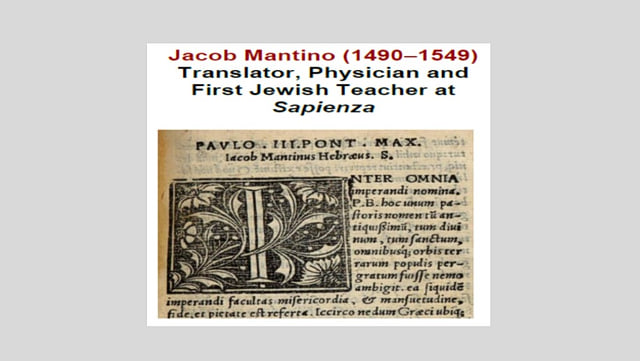
Conference "Jacob Mantino (1490–1549). Translator, Physician and First Jewish Teacher at Sapienza,” Sapienza University of Rome, Italy
Date
30 May 2023
Lecture
The Textual Tradition of Averroes’s Epitome of Aristotle’s Metaphysics on the Arabic-Hebrew-Latin Continuum
Yoav Meyrav and Michael Engel
The lecture sketched the twists and turns of the Arabic text and Hebrew translation of Averroes’s epitome of the Metaphysics until it reached the form in which it was available to Mantino for his Latin translation.
Further information
Link to conference programme (PDF)
28 March 2023 | Lecture in Cambridge | Yoav Meyrav
Venue
Conference “Truth and Time in the Middle Ages,” Centre for Research in the Arts, Social Sciences and Humanities (CRASSH), Cambridge University, UK
Date
28 March 2023
Lecture
A Hebrew Scribe’s Note About Infinite Power and Eternal Motion
Yoav Meyrav
The lecture analyzed an original philosophical argument found as an interpolation in a manuscript of a metaphysical work.
Further information
Link to conference programme